The vivid reds, electric blues, and iridescent greens of show-quality bettas are not genetic luck — they are the direct result of what those fish were fed. Carotenoid metabolism is the bridge between diet and colour expression, and it is entirely controllable.
How fish produce colour.
Fish cannot synthesise carotenoids endogenously — they must acquire them through diet. Once ingested, carotenoids are transported to chromatophores (pigment cells) in the dermis, where they are deposited and expressed as visible colour. The efficiency of this process depends on two factors: the bioavailability of the carotenoid source and the health of the gut lining responsible for absorption.
Why natural carotenoids outperform synthetic ones.
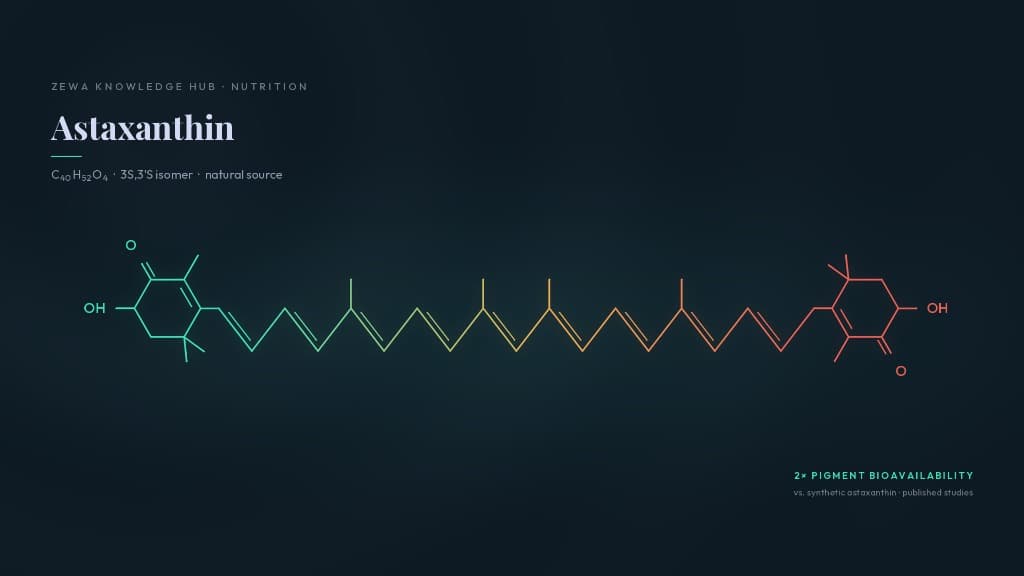
Synthetic astaxanthin — the most common colour-enhancing additive in commercial fish food — contains a mixture of three optical isomers (3S,3'S; 3R,3'S; and 3R,3'R in a 1:2:1 ratio). Natural carotenoid sources, by contrast, are dominated by the 3S,3'S isomer, which research has shown to exhibit higher antioxidant activity and more efficient absorption in aquatic organisms.
The advantage of natural carotenoids extends beyond isomer profile. When carotenoids are delivered within a lipid-rich matrix — such as the insect oils and fish oils present in Zewa formulas — they are co-packaged with the fatty acids and phospholipids that the gut uses to solubilise and absorb fat-soluble compounds. This matrix effect significantly improves the fraction of carotenoid that actually reaches the chromatophores. Published studies on ornamental fish have demonstrated that natural astaxanthin produces measurably superior coloration compared to synthetic astaxanthin at equivalent doses, with one peer-reviewed study recording a 15% higher colour intensity value in fish fed natural sources.
Colour is nutrition made visible. Every shade of red in a show betta is a direct measurement of what it ate six weeks ago.
What this means in practice.
In internal feeding observations over 21 days, bettas fed Betta Bites F3 showed noticeable improvement in scale iridescence and fin colour saturation within the first two weeks — without any synthetic pigment additives. The mechanism is not colour enhancement in the cosmetic sense; it is simply removing the nutritional bottleneck that was preventing full genetic expression.
Betta Bites F3 delivers 46% insect protein with 88% pepsin digestibility, meaning more nutrients are absorbed per feeding and less metabolic waste is produced. The high digestibility of the protein base also supports a healthier gut lining — the very tissue responsible for absorbing carotenoids in the first place. A fish with poor gut health wastes even the best pigment sources. A fish on a highly digestible, nutrient-dense diet absorbs more of everything, carotenoids included.
This is why colour outcomes in ornamental fish are inseparable from overall feed quality. Protein digestibility, lipid matrix, carotenoid source, and gut health are not separate variables — they are parts of a single nutritional system. Zewa formulas are designed to optimise that entire system, not just add pigment on top of an otherwise deficient diet.
- 1
Mutale-Joan, C. & El Arroussi, H. (2023). Comparative effects of natural astaxanthin from Haematococcus pluvialis and synthetic astaxanthin on pigmentation in ornamental fish at 100 mg/kg inclusion.
- 2
EFSA FEEDAP Panel (2014). Scientific Opinion on the safety and efficacy of synthetic astaxanthin as a feed additive — optical isomer composition (3S,3'S : 3R,3'S : 3R,3'R in a 1:2:1 ratio). View source